
GD&T Orientation Dimension Definitions
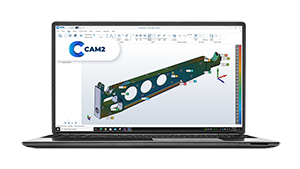
Orientation Controls — Overview
Orientation tolerances control the angular relationship of a feature relative to a datum. In CAM2®, a controlled feature and a datum feature are required. The datum is considered theoretically perfect and infinite, while the tolerance applies only over the length or area of the controlled feature. For meaningful results, the larger or more stable feature should be selected as the datum.
Parallelism
Parallelism controls the condition of a surface or axis relative to a datum so that it remains equidistant from the datum feature. For surfaces, the feature must lie within two parallel planes separated by the tolerance value. Lack of parallelism can result in gaps during assembly.
Applicable to planar and line‑reducible features.
Perpendicularity
Perpendicularity controls the orientation of a feature at 90 degrees to a datum. The controlled feature must lie within a tolerance zone oriented perpendicular to the datum. Excessive deviation may cause gaps or interference in assembly.
Applicable to planar and line‑reducible features.
Concentricity
Concentricity controls the alignment of a feature’s axis with a datum axis. It is used to verify that cylindrical features, such as a pin and hole, share a common axis. Misalignment may result in interference.
Keywords:
GD&T, parallelism, perpendicularity, concentricity, orientation